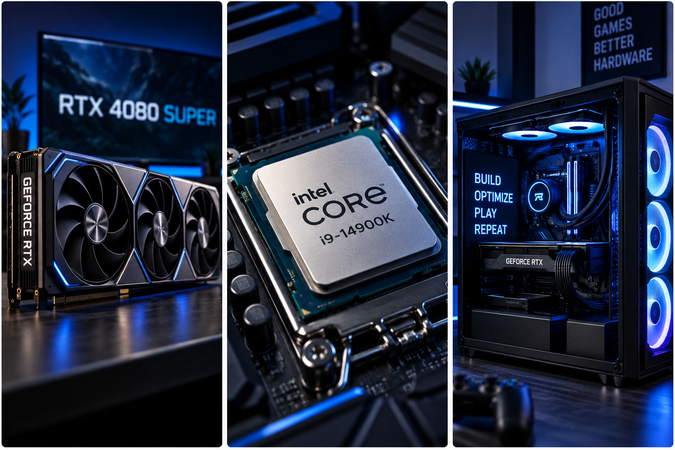
The NVIDIA GeForce RTX 4080 Super remains an extremely powerful graphics card for gamers targeting high-refresh-rate 1440p and premium 4K gaming.
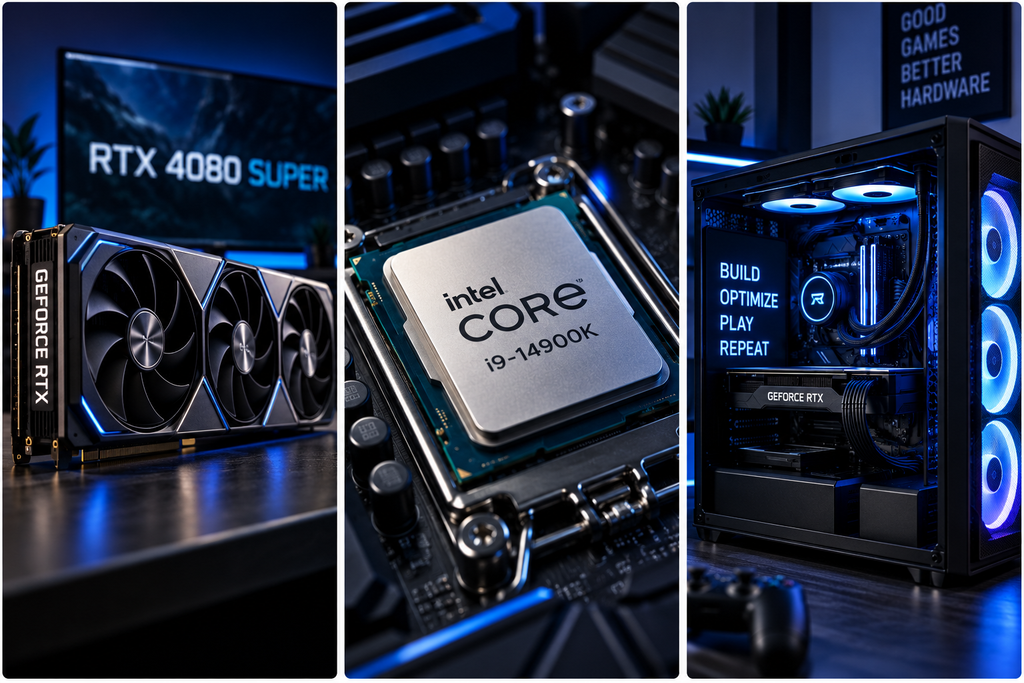
Built for demanding AAA games, ray tracing, high-resolution textures and GPU-accelerated workloads, the RTX 4080 Super combines strong rasterization performance with NVIDIA technologies such as DLSS and Frame Generation.
But raw frame rate is only part of the story.
A high-end GPU should also deliver strong thermal behavior, manageable power consumption, low noise and enough graphics memory for modern games.
In this guide, we look at the RTX 4080 Super from a practical gaming perspective.
RTX 4080 Super Key Specifications
The RTX 4080 Super is positioned as a high-end graphics card for gamers who want performance well beyond mainstream GPUs.
Key characteristics include:
- 16GB of GDDR6X VRAM
- strong 1440p performance
- high-end 4K capability
- hardware-accelerated ray tracing
- DLSS support
- Frame Generation support
- AV1 encoding
- strong productivity performance
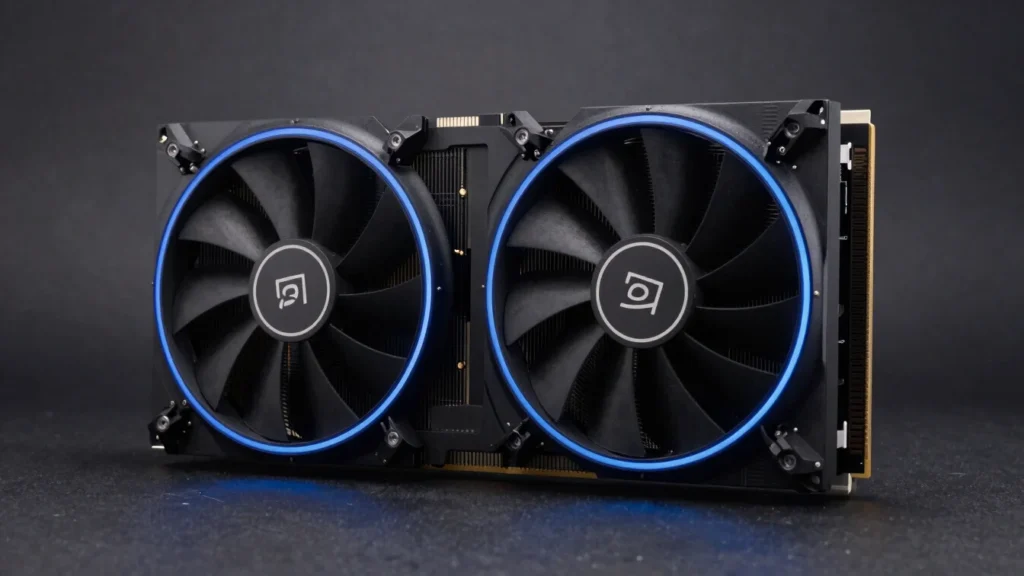
- large cooling solutions on many partner models
The 16GB VRAM capacity is particularly useful for high-resolution textures and modern games at 1440p and 4K.
1080p Gaming Performance
At 1080p, the RTX 4080 Super is usually far more powerful than most gamers need.
In many games, performance can become limited by the CPU before the graphics card reaches its full potential.
This makes the card more suitable for:
- competitive gaming on extremely high-refresh displays
- 240Hz and 360Hz monitors
- heavily modded games
- ray tracing
- users planning to upgrade to 1440p or 4K later
For a normal 1080p 144Hz gaming setup, less expensive GPUs generally provide better value.
1440p Gaming Performance
1440p is one of the best resolutions for the RTX 4080 Super.
At this resolution, the GPU can deliver extremely high frame rates while allowing users to increase graphics settings significantly.
It is especially suitable for:
- 1440p 165Hz monitors
- 1440p 240Hz displays
- competitive games
- AAA gaming
- ray tracing
- ultra-quality textures
Gamers looking for a premium 1440p experience will generally have substantial performance headroom.
This can also help extend the useful life of the system as games become more demanding.
4K Gaming Performance
4K is where the RTX 4080 Super makes the most sense.
Rendering at 3840 × 2160 requires significantly more GPU power than 1080p or 1440p.
The card’s combination of processing performance and 16GB VRAM makes it well suited for modern 4K gaming.
Players can often use high or ultra graphics settings while still maintaining smooth performance.
For particularly demanding ray-traced games, DLSS can provide an important performance boost.
DLSS and Frame Generation
One of the biggest advantages of modern NVIDIA GPUs is DLSS.
DLSS can render a game internally at a lower resolution and intelligently reconstruct the image to a higher output resolution.
This can improve frame rates significantly, especially at 4K.
Frame Generation can further increase perceived smoothness in compatible games by generating additional frames.
These technologies are particularly useful when enabling demanding effects such as ray tracing.
However, native performance remains important.
Not every game supports DLSS or Frame Generation, so buyers should evaluate both native and upscaled benchmarks when comparing GPUs.
Ray Tracing Performance
Ray tracing can dramatically improve reflections, shadows and lighting.
It can also dramatically increase GPU workload.
The RTX 4080 Super is powerful enough to make ray tracing practical in many modern games.
At 1440p, users can often combine high ray-tracing settings with excellent frame rates.
At 4K, DLSS becomes more valuable.
The exact results depend heavily on the game engine and implementation.
16GB VRAM: Is It Enough?
For most modern gaming workloads, 16GB provides excellent headroom.
It is suitable for:
- 1440p ultra textures
- 4K gaming
- high-resolution texture packs
- ray tracing
- game modifications
- content creation
- GPU-accelerated applications
VRAM usage varies from game to game.
Having 16GB does not guarantee better FPS than every lower-memory graphics card, but it reduces the risk of graphics-memory limitations in demanding scenarios.
Temperature and Cooling
Thermal performance depends significantly on the specific graphics-card model.
Premium partner cards often use:
- triple-fan cooling
- large heatsinks
- vapor chambers
- multiple heat pipes
- semi-passive fan modes
A well-cooled RTX 4080 Super can maintain strong sustained clock speeds while keeping fan noise reasonable.
Case airflow remains important.
Even the best graphics-card cooler cannot perform properly inside a poorly ventilated case.
For best results, make sure your case has good front intake and rear or top exhaust airflow.
Power Consumption
High-end GPUs naturally consume more power than mainstream cards.
This means the quality of your power supply matters.
Your PSU should provide:
- adequate wattage
- high efficiency
- quality internal components
- the appropriate GPU power connector
- enough headroom for CPU power spikes
Do not choose a power supply based only on total wattage.
A high-quality PSU from a reputable manufacturer is preferable to a cheaper unit with an exaggerated wattage rating.
RTX 4080 Super for Content Creation
The RTX 4080 Super is not limited to gaming.
Its GPU acceleration can also benefit:
- video editing
- 3D rendering
- AI applications
- Adobe applications
- streaming
- Blender
- GPU encoding
- creative workloads
The 16GB VRAM capacity is especially valuable when handling larger projects.
Who Should Buy the RTX 4080 Super?
The RTX 4080 Super makes the most sense for gamers who:
- play primarily at 1440p or 4K
- use high-refresh-rate monitors
- want ray tracing
- play demanding AAA games
- want 16GB VRAM
- stream or create content
- plan to keep their GPU for several years
Who Should Skip It?
Consider a cheaper GPU if:
- you only play at 1080p
- you use a 60Hz display
- you primarily play lightweight esports titles
- you have a limited system budget
- your CPU would severely bottleneck the card
Pros
- Excellent 1440p performance
- Strong 4K capability
- 16GB VRAM
- Excellent ray-tracing support
- DLSS and Frame Generation
- Strong content-creation performance
- AV1 encoding support
Cons
- Expensive
- High power requirements
- Physically large models
- Overkill for many 1080p systems
- Requires a balanced high-end PC
Frequently Asked Questions
Is the RTX 4080 Super good for 4K gaming?
Yes. 4K gaming is one of its strongest use cases.
Is 16GB VRAM enough?
For most current 1440p and 4K gaming workloads, 16GB provides strong headroom.
Do I need DLSS?
No, but DLSS can significantly improve performance in demanding games.
Is the RTX 4080 Super good for streaming?
Yes. Its hardware encoding capabilities make it suitable for gaming and streaming systems.
Final Thoughts
The RTX 4080 Super is best suited to enthusiasts who want a premium gaming experience without immediately moving to the very highest GPU tier.
Its strongest advantages are excellent 1440p and 4K performance, 16GB VRAM, ray tracing and NVIDIA’s software ecosystem.
For gamers with a powerful CPU, high-resolution monitor and sufficient budget, it remains a highly capable graphics card.